










Introduction
The internet gives us access to more information than ever, but having more information does not always mean having better information. A headline can look convincing, a social media post can sound confident, and a polished website can make a weak claim appear credible.
The real skill is knowing which online informationdeserves your time and which information can be ignored.
You do not need to investigate every post, article, video, or comment you encounter. Instead, you can use a few practical habits to quickly assess whether something is relevant, trustworthy, and useful. This guide explains how to evaluate online information, identify stronger sources, recognize warning signs, and decide when something is actually worth your attention.
Why It Matters What Information You Give Your Attention To
Your attention is limited. Every article you read, video you watch, notification you open, and argument you follow takes some amount of mental energy.
Low-quality information can create several problems:
- It can waste your time.
- It can make simple topics seem unnecessarily complicated.
- It can spread inaccurate claims.
- It can encourage emotional reactions before you understand the facts.
- It can make it difficult to distinguish important information from noise.
This does not mean everything online needs to be treated with suspicion. The goal is not to distrust the internet. The goal is to become better at deciding what deserves deeper attention.
1. Start by Asking: Why Am I Reading This?
Before evaluating the quality of information, consider why you clicked on it.
Are you:
- Looking for an answer?
- Researching a topic?
- Trying to make a decision?
- Learning something new?
- Checking whether a claim is true?
- Simply browsing for entertainment?
Your purpose changes what information you actually need.
For example, an opinion article may be perfectly suitable if you want to understand someone’s perspective. But if you are researching a factual question, you may need stronger evidence and more authoritative sources.
Useful information is information that helps you accomplish your specific goal.
2. Look Beyond the Headline
Headlines are designed to make people click.
Some are informative and straightforward. Others use curiosity, surprise, fear, or outrage to attract attention.
A headline such as:
“You Won’t Believe What Experts Just Discovered”
does not tell you much about the actual claim.
Before deciding whether something is important, read enough of the content to understand:
- What is being claimed?
- Who is making the claim?
- What evidence supports it?
- When was the information published?
- Does the source provide supporting references?
A dramatic headline is not automatically wrong, but it should not be treated as evidence.
3. Check Who Published the Information
One of the quickest ways to evaluate online content is to identify its source.
Look for:
- The publication or organization
- The author
- The author’s relevant expertise
- The publication date
- An About page
- Contact information
- References or supporting sources
A recognizable organization is not automatically correct, and an unfamiliar website is not automatically unreliable. However, knowing who produced the information gives you important context.
Ask yourself:
Who is responsible for this information?
If you cannot identify an author, organization, or accountable publisher, consider whether the information deserves much confidence.
4. Check the Date
Information can become outdated surprisingly quickly.
This is especially important for topics involving:
- Technology
- Software
- Prices
- Travel
- Laws and regulations
- Sports
- Health recommendations
- Business trends
- Current events
An older article might still provide useful background, but it should not automatically be treated as current.
For example, an article explaining a technology concept from several years ago may remain useful. A guide containing old software instructions may not.
Always ask whether the date matters for the question you are trying to answer.
5. Separate Facts From Opinions
Online content frequently mixes factual information with personal interpretation.
Consider a statement such as:
“This is the best productivity app available.”
That is primarily an opinion unless the writer establishes a clear definition of “best” and provides evidence for the comparison.
Compare it with:
“The application includes calendar integration, task management, and reminders.”
That is a claim that can be checked against the product’s actual features.
Watch for language such as:
- Best
- Worst
- Everyone
- Nobody
- Always
- Never
- Guaranteed
- Proven
- Experts agree
These words do not automatically make a statement false. They simply deserve closer examination because broad claims often require strong evidence.
6. Look for Evidence, Not Just Confidence
A person can sound extremely confident and still be wrong.
Strong online information generally makes it possible to examine how its conclusions were reached.
Depending on the topic, useful supporting material may include:
- Official documents
- Primary sources
- Research papers
- Public records
- Direct statements
- Original data
- Transparent methodology
- Multiple independent sources
The type of evidence that matters depends on the claim.
For example, if someone claims that a government agency changed a rule, an official government source is usually more useful than a random social media post discussing the change.
7. Compare Important Claims With Other Sources
You do not need to cross-check every sentence you read.
Instead, focus on information that could materially affect your decision.
If an article makes an important claim, search for the same subject elsewhere.
For example:
Source A: Makes a surprising claim.
Source B: Provides additional context.
Source C: Offers primary documentation or another independent perspective.
When several credible sources agree on the basic facts, your confidence can increase.
If reliable sources disagree, that disagreement is itself useful information. It may mean the subject is uncertain, complicated, or still developing.
8. Be Careful With Social Media
Social media is useful for discovering information, but a post’s popularity does not establish its accuracy.
A post can receive thousands of likes because it is:
- Entertaining
- Emotional
- Controversial
- Easy to understand
- Aligned with what people already believe
None of these factors proves that the underlying claim is correct.
When you see an interesting claim on social media, treat the post as a starting point for investigation, rather than automatically treating it as the final source.
9. Watch for Emotional Manipulation
Content that creates a strong emotional reaction can capture your attention quickly.
Common emotional triggers include:
- Fear
- Anger
- Shock
- Outrage
- Excitement
- Anxiety
- Curiosity
Emotion itself is not evidence.
If a piece of content makes you immediately want to share it, argue about it, or warn everyone you know, pause for a moment.
Ask:
“Would I still believe this if the information were presented in a calm and neutral way?”
That simple question can help separate the message from the emotional packaging around it.
10. Understand the Difference Between a Source and a Citation
A page may contain many links and still provide weak evidence.
For example, an article might say:
“Studies show…”
but never identify the study.
Another article may link to a source that does not actually support the claim being made.
When you see a citation, check what it actually says.
A useful habit
Do not stop at:
“They included a link.”
Ask:
“Does that link support the specific statement?”
This small distinction can significantly improve the quality of online research.
11. Be Careful With Statistics
Numbers can make content appear authoritative.
But statistics need context.
Suppose an article says:
“This method improves results by 50%.”
That sounds impressive, but several questions remain:
- 50% of what?
- Compared with what?
- Over what period?
- How large was the sample?
- How was the result measured?
- Where did the number come from?
A statistic without context can create a misleading impression.
Whenever a number appears important to an argument, try to find its original source and understand what it actually measures.
12. Consider the Website’s Purpose
Every website has a reason for publishing content.
Some exist primarily to:
- Educate
- Report news
- Sell products
- Generate advertising revenue
- Build an audience
- Promote a particular viewpoint
- Entertain
A commercial website can still provide excellent information. However, understanding its purpose helps you recognize potential biases.
For example, a company recommending its own product has a different perspective from an independent reviewer comparing several products.
That does not make the company’s information useless. It simply means you should understand the context.
13. Learn to Recognize Common Warning Signs
Certain patterns should make you slow down before trusting or sharing information.
Warning signs include:
- No identifiable author
- No publication date
- Extraordinary claims with little evidence
- Excessive use of sensational language
- Unsupported statistics
- Fake-looking expert references
- Claims that “everyone” or “experts” agree without evidence
- No links to original sources
- Information that encourages immediate sharing
- Several unrelated claims presented as if they prove one another
One warning sign does not automatically make an article unreliable.
Think of these signs as reasons to investigate further, not as automatic proof that something is false.
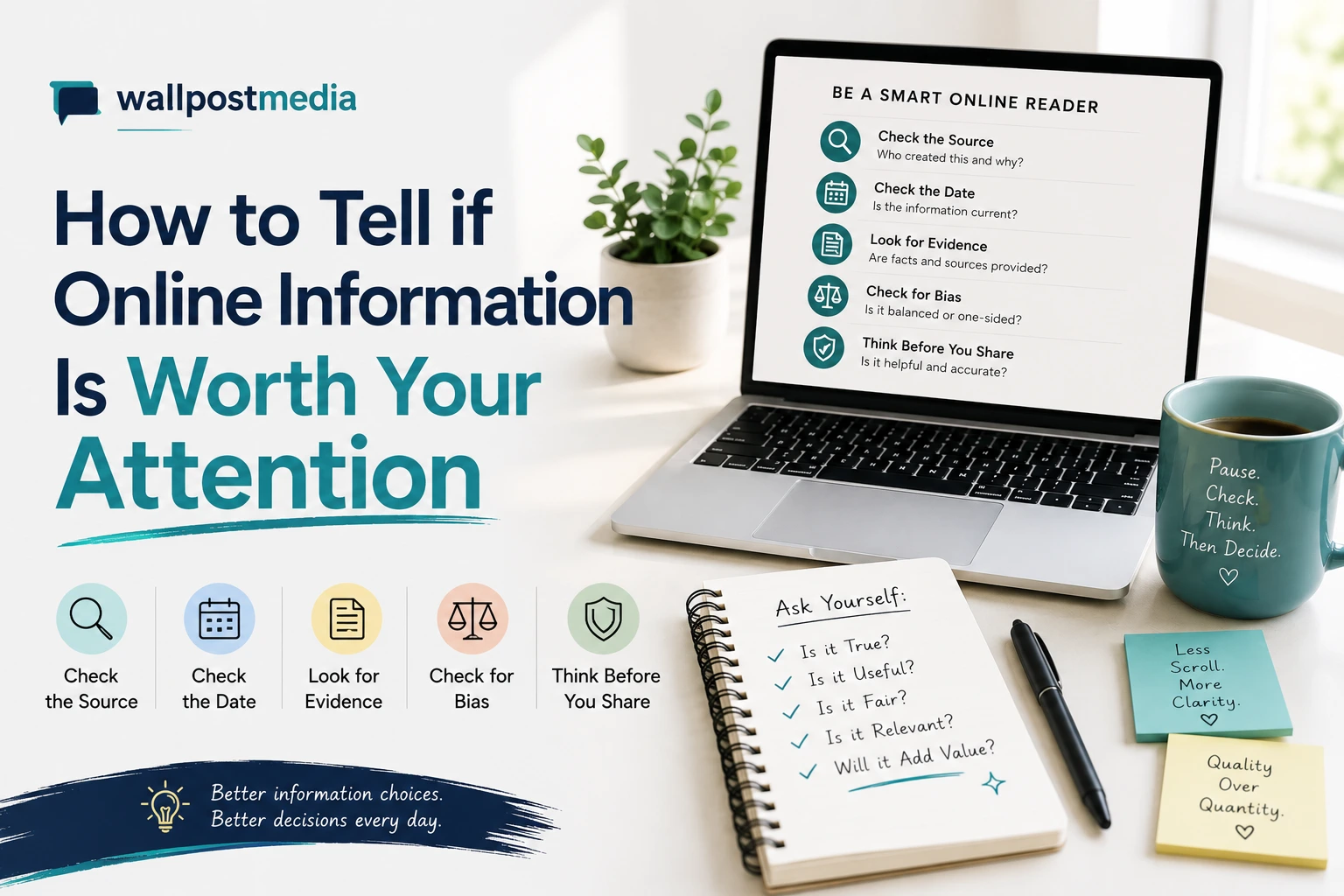
14. Use a Simple 5-Question Information Check
If you need a quick method, ask these five questions:
| Question | What to Check |
|---|---|
| Who? | Who created or published it? |
| When? | Is the information current enough? |
| Why? | What is the purpose of the content? |
| Evidence? | What supports the main claims? |
| Elsewhere? | Can important claims be confirmed independently? |
This approach is simple enough to use while browsing without turning every article into a research project.
15. Decide How Much Attention the Information Deserves
Not every piece of information requires the same level of investigation.
A useful approach is to divide online content into three levels.
Low importance
Examples:
- A casual opinion
- Entertainment content
- A funny post
- A minor personal recommendation
You may not need extensive verification.
Medium importance
Examples:
- A product comparison
- A travel recommendation
- A career article
- A financial planning discussion
It is worth checking the source and comparing important claims.
High importance
Examples:
- Major financial decisions
- Legal matters
- Safety information
- Significant purchases
- Important professional decisions
For these topics, use stronger sources and verify important claims carefully.
The more a piece of information can affect your life, the more carefully you should evaluate it.
16. Create a Better Online Information Habit
You do not need to become a professional fact-checker.
Instead, develop a few repeatable habits.
Try this simple routine:
Pause → Identify → Check → Compare → Decide
Pause: Don’t immediately react to surprising information.
Identify: Determine what the actual claim is.
Check: Look at the source, author, date, and evidence.
Compare: Search for confirmation when the claim matters.
Decide: Determine whether the information is useful enough to keep, share, or act on.
Over time, this process becomes faster and more natural.
How to Avoid Information Overload
Evaluating information is useful, but constantly researching everything can become exhausting.
You also need to decide what not to consume.
Try these habits:
- Unsubscribe from unnecessary newsletters.
- Mute accounts that repeatedly create noise.
- Save useful resources instead of constantly searching for them.
- Avoid opening every notification.
- Set specific times for catching up on news.
- Stop reading when you already have enough information to make your decision.
- Keep a small collection of trusted sources for topics you regularly follow.
The objective is not to consume the maximum amount of information.
It is to consume enough reliable information to make better decisions.
A Practical Example
Imagine you see a social media post claiming that a particular productivity technique will dramatically improve your work.
Instead of immediately accepting or rejecting it, use the five-question check:
Who?
Is there an identifiable author or organization?
When?
Is the post based on current information or an old claim?
Why?
Is the creator educating you, selling something, or simply generating engagement?
Evidence?
Does the post provide meaningful evidence?
Elsewhere?
Can the main claim be confirmed through credible independent sources?
After those checks, you may decide that the technique is worth trying, worth researching further, or simply not worth your time.
That is the real goal of evaluating online information: making better attention decisions.
FAQ: Evaluating Online Information
How can I tell if online information is reliable?
Check who published it, when it was published, what evidence supports it, and whether important claims can be confirmed through other credible sources. Avoid judging reliability solely by how professional or confident a page appears.
What is the fastest way to check online information?
Start with five questions: who published it, when it was published, why it exists, what evidence supports it, and whether other credible sources confirm the claim. This quick check can identify many weak sources without requiring extensive research.
Should I trust information shared on social media?
Social media can help you discover useful information, but popularity does not prove accuracy. For important claims, follow the information back to its original source and verify it independently.
How do I know whether a website is trustworthy?
Look for an identifiable publisher, author information, publication dates, transparent sourcing, and clear supporting evidence. A trustworthy website should make it reasonably easy to understand where its information comes from.
Why should I check the date of an online article?
The publication date helps you determine whether the information is still relevant. Dates are particularly important for subjects that change frequently, such as technology, regulations, prices, sports, and current events.
Do I need to fact-check everything I read online?
No. The amount of checking should depend on how important the information is and what you plan to do with it. Spend more time verifying information that could significantly affect your money, safety, decisions, or other important areas of life.
Conclusion
The ability to evaluate online information is less about knowing everything and more about knowing what deserves your attention.
Before trusting an important claim, check the source, date, purpose, evidence, and supporting information from elsewhere. Be especially cautious when content uses strong emotional language, dramatic headlines, or impressive statistics without sufficient context.
Most importantly, remember that your attention is valuable. You do not need to investigate every piece of content you encounter. Learn to recognize what is useful, verify what matters, and confidently move past information that adds more noise than value.
For more practical ideas on navigating everyday digital life, keep exploring WallPostMedia for useful, easy-to-apply guidance.